Today, anyone can apply for a credit or debit card through a banking app, transfer funds between accounts, or set up automatic bill payments. However, while these changes may be convenient for a large segment of society, there is also a significant portion of the population that faces certain difficulties and accessibility barriers: older adults. Far from being a small group, baby boomers are the cohort that remains most loyal to their bank and has built up their financial wealth over decades. However, digitalization (complex designs, apps, memorizing passwords) and the closure of bank branches have made it difficult for them to participate independently.
For this reason, banks must develop signature processes for senior clients that are straightforward, secure, and can be completed in just a few steps, while providing all necessary legal safeguards.
Challenges of Traditional and Digital Signatures for Senior Clients
Although a large number of people carry out transactions such as transfers, banking apps, or mobile payments on a daily basis, completing formal procedures and accepting terms and conditions in the financial sector remains a veritable maze for senior clients when it comes to signing.
Over the years, this group has seen new tools emerge that—although designed to simplify daily tasks—represent a major digital leap and have not yet fully taken root among them. In other words: while the theory sounds great, the reality is that technology has not always been accompanied by genuine adaptation.
The findings are included in the fifth edition of the study “Habits and Perceptions of Spaniards Regarding the Banking Sector 2026,” prepared by Nickel, and reveal two main findings:
- 44.5% of Spaniards believe that the banking system is not accessible to older adults.
- Only 8.7% believe it is accessible to everyone.
For an older adult, it presents multiple barriers:
Geographical Exclusion and Lack of Branches
Thousands of branches and ATMs have closed in recent years. Many people even have to travel to other municipalities to carry out administrative procedures or banking transactions because these services have completely disappeared from their area.
The Excessive Number of Digital Steps
Completing a transaction remotely often requires a series of technical steps that are unrealistic: downloading apps, deciphering PDF documents dozens of pages long on small screens, and navigating security validations with tight time limits. Steps that are routine for a digital native become overwhelming for a senior clients.
Mistrust and Fear of Fraud
Despite technological advances, for a large number of people, digitization remains synonymous with anxiety. The idea of completing administrative tasks digitally—whether via a cell phone, a tablet, or from the office itself—is met with resistance, especially as news of digital fraud spreads like wildfire.
Digital Signatures for Senior Clients in Banking Transactions: What Are They?
Whether they involve deposit transactions (the client deposits money with the bank), loan transactions (the bank lends money to the client), or neutral transactions (brokerage), there are several digital signature options designed to streamline processes and procedures.
Just as in any other sector, all three types of signatures—simple, advanced, and qualified—can be used in banking. Depending on the transaction you wish to carry out, one type may be more suitable than another:
- Simple signature: A single tap on the screen is sufficient. Ideal for procedures that involve no risk and no financial commitments: Acceptance of electronic data, commercial communications, scheduling an appointment, or updating contact information.
- Advanced signature: Uniquely linked to the signer and allows for their identification. It detects any changes made after the signature. This type of signature is used when, for example, a customer receives an SMS code, when applying for credit cards, personal loans, or insurance policies.
- Qualified signature: This is too complex for a senior user to use on their own. For this reason, it is recommended that the bank offer a guided phone call or assist the customer. This would be the option of choice for taking out mortgages, high-value transactions, or the pledging of funds.
The Advanced Electronic Signature as Key to the Banking Process
While the qualified signature is equivalent to a handwritten signature and offers the highest level of security, if the goal is to help senior clients get used to signing banking documents online, the best option is to use the advanced electronic signature in 80–90% of cases. The electronic evidence incorporated into the advanced electronic signature allows the signer to be identified unequivocally, ensuring the signer retains control and preventing subsequent alterations.
Evidence Document for Senior Clients’ Banking Transactions
The evidence document (Audit Trail) automatically generated by Viafirma after a signature is particularly important. This is the evidence you must provide in the event of any legal claim, as it collects and securely stores the evidence of the transaction with a timestamp.
In the remaining 20–10% of cases, when the use of a qualified signature is required by law, it is recommended to assist the senior clients in front of the screen. The good news is that, currently, there are options designed to make these types of transactions as easy as possible and to foster senior clients loyalty.
Instead of requiring senior clients to install a digital certificate on a computer, the digital certificate manager allows for centralization on a secure server and the management of controlled usage policies. This way, a senior client could delegate signatures to a trusted family member, while maintaining traceability, clearly defined permissions, and control over which documents are signed on their behalf.
Ensuring Accessibility in the Signing Process for Senior Clients
With technology now serving as the guiding star of business strategies, banks must leverage cutting-edge tools to ensure security and design an optimal experience for all users, including senior clients.
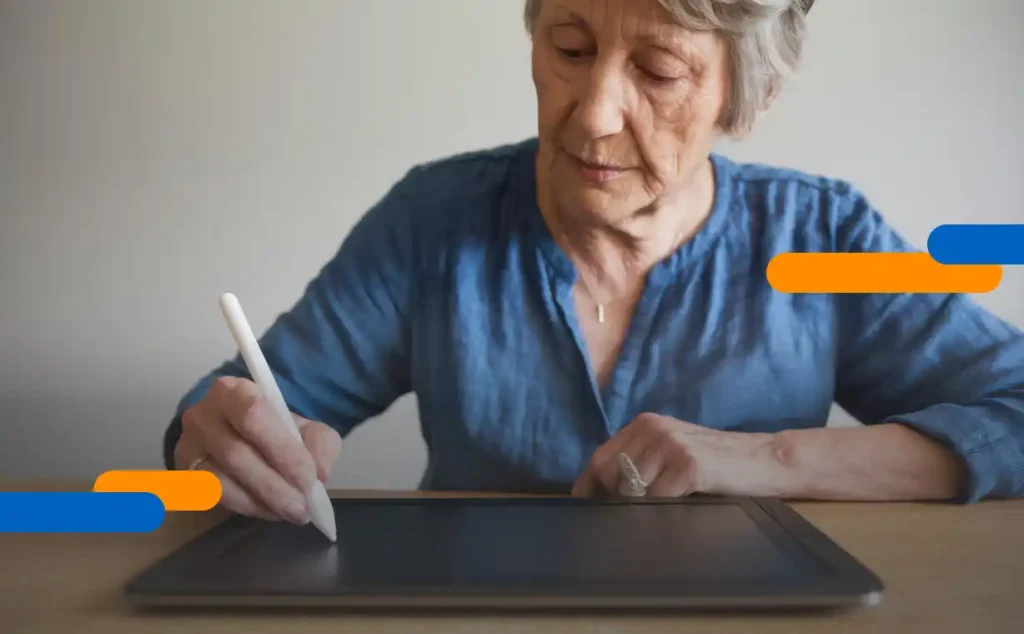
Viafirma, as a one-click signature solution for senior clients, demonstrates that ease of use and legal security can coexist seamlessly. And when a banking process is so clear, straightforward, and easy to follow that a 70-year-old can sign it with confidence, it becomes the best service a bank can offer.
Are you looking to offer an accessible and secure signing process for senior clients? Contact our sales team and learn how to implement one-click signing with Viafirma.
Related articles