
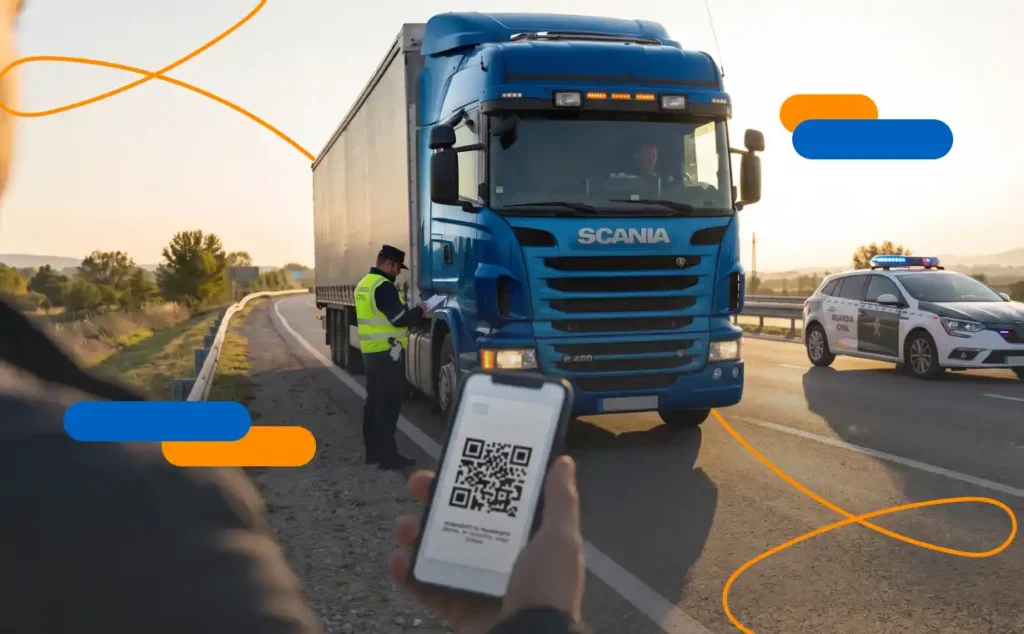
From 5 October 2026, any haulier who does not carry a duly completed DeCA on board their vehicle will face a financial penalty. Legally, there will be no turning back. However, not all offences committed will be the same, nor will the fines they are required to pay.
In today’s article, we explain the penalties and fines for failing to comply with the DeCA, as well as the reasons that may lead to you facing these consequences.
Reasons that may result in fines if you fail to comply with the DeCA
Many professionals believe they can only be penalised if they do not carry the DeCA inside the vehicle. This is not the case. In practice, errors may occur that prevent the traceability of the load or the validity of the digital record from being verified.
The specific causes that trigger these penalties are:
- Failure to carry the DeCA: Regardless of the reason, the document must always be accessible on every single journey.
- Having an incomplete DeCA: The driver is carrying the document but essential details are missing, which may include the parties involved, the origin and destination of the goods being transported, the goods themselves, the vehicle registration number or the date.
- Failure to complete the form: The document has not been completed as required.
- The document is in paper form but not in electronic format: From 5 October 2026, only the digital version of the document will be valid. Carrying a physical copy of the delivery note will no longer be of any use.
Types and amounts of fines for non-compliance with the DeCA
These are the three levels of penalty you may face if there is a problem with the control document:
- Minor penalty. In certain circumstances, the authorities may, giving reasons, determine that the defect is of no significance. The fine ranges from €100 to €400.
- Serious penalty (Art. 141.17 LOTT). Broadly speaking, this covers all the reasons mentioned above (omission, failure to complete the form or lack of essential data) where there is no DeCA or something is missing from it. This is usually the most common fine and ranges from €401 to €600.
- Very serious penalty (Art. 143.4 LOTT). This is the most serious penalty that can be imposed, as it involves distorting the facts by falsifying the document or the information it contains. The fine ranges from €4,001 to €6,000, and may rise to between €6,001 and €18,000 if there is already a final administrative decision for another very serious offence within the previous 12 months.
First and foremost, bear in mind that, although there are three levels of penalties, the financial amount to be paid is not a fixed sum. To determine the amount to be paid, Article 143.1 of the LOTT sets out five criteria that the competent authorities must take into account:
- Social impact of the offence
- Intent
- Nature of the damage caused
- Unlawfully obtained profit
- Repeat or habitual offence
In addition to the above, the authorities will check whether there have been any previous penalties.
Administrative consequences and operational inefficiencies
Although the prospect of a financial penalty causes considerable concern, the truth is that, if you find yourself in this situation, paying a fine may be the least of your worries. Beyond a financial penalty, breaching the DeCA can result in a significantly higher cost:
Vehicle immobilisation and delays in the supply chain
Until the incident is resolved, traffic officers may order the lorry to be immobilised. Although this is not the general rule, it does apply in certain circumstances, as set out in Article 143.4 of the Land Transport Organisation Act (LOTT).
In some cases, the issue will be resolved quickly, but in others it may occur at night or at the weekend. This would mean the haulier having to stay overnight with the goods, but it would also throw route planning into disarray and cause delays in delivery to the destination.
Suspension of licences and refusal of new licences
Accumulating open disciplinary proceedings or debts arising from unpaid fines brings administrative procedures to a standstill. You will not be able to obtain new operating licences, use the licences you already hold, or transfer the vehicles subject to sanctions until you have paid the corresponding amount.
It accumulates on your record
Every penalty incurred is recorded in the Register of Transport Companies and Activities. Furthermore, repeat offences increase the severity of the next penalty, and those classified as very serious offences may affect the transport manager’s good standing.
Frequently asked questions about the DeCA
Who pays the fine?
This is one of the most frequently asked questions amongst professionals. And the short answer is that liability for payment varies depending on where the fault originated.
The contractual shipper is the person responsible for contracting and paying for the transport. They are responsible for the shipment details appearing on the document: the tax identification number, the actual carrier’s details, the description of the goods, and the places of origin and destination. If these details are incorrect, false or incomplete, the liability for the infringement falls on them.
For their part, the actual carrier is responsible for ensuring the document is available on board in a valid format: a native digital PDF with a legible QR code, or on a mobile phone. During checks, they must present the document, and no excuse is accepted (such as the mobile phone running out of battery, having only a paper copy, or a system failure). The carrier is also responsible for the date and the vehicle registration number.
In the event that the control document has not been issued, both the contractual shipper and the actual carrier may each be fined.
Are there any vehicles that are exempt?
Yes. Order FOM/2861/2021 excludes transport operations without a valid licence, certain parcel delivery services, those transporting damaged vehicles and, finally, vehicles used for removals.
Viafirma puts the DeCA in your hands
Time is running out and the clock won’t stop on 5 October. Waiting until the last minute only increases the risk of making documentation errors, suffering delays on the road and facing financial and administrative penalties.
Viafirma allows you to digitise, manage and sign the DeCA quickly, intuitively and in full compliance with current regulations. Ensure the smooth operation of your vehicles, protect your company’s reputation and optimise the traceability of every consignment starting today.
What are you waiting for? Contact our sales team and find out how to easily transition your road haulage operations to a digital environment.
Related articles