
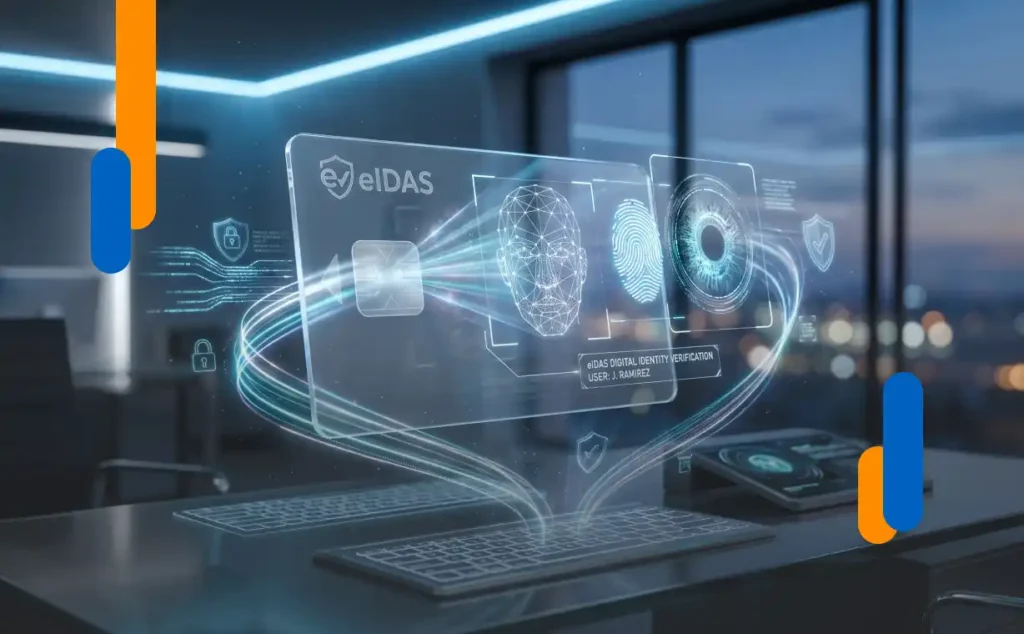
Have you ever needed to sign a document from another European Union member state, but weren’t sure if you could do so? Completing administrative procedures for Italy, Portugal or Germany from the comfort of your sofa is possible thanks to electronic identification via the eIDAS system.
With this system, public administrations across different member states can communicate with one another, verifying the identity of any EU citizen securely and with full legal guarantees.
Would you like to learn how to use this little-known identification system, which opens up international borders for you? In this article, we’ll explain how you can use this system in your day-to-day life, what documents you need to identify yourself correctly, and the step-by-step process you should follow so that international procedures don’t catch you off guard again.
What eIDAS identification methods can you use in Spain?
Before delving into eIDAS identification as the main focus of this article, it’s worth briefly reviewing the different identification methods you can use in Spain.
In Spain, citizens and businesses have access to various tools that are already fully accredited at European level under the eIDAS framework in Spain:
- The electronic ID card (DNI): An identity document containing a cryptographic chip, which securely verifies your identity online and enables you to carry out government procedures online, as well as sign digital documents. It is classified as ‘High’ security.
- The Cl@ve system: A Spanish Government platform designed to unify and simplify your electronic identification within the public administration, enabling you to access various platforms (Social Security, DGT, etc.).
- Qualified digital certificates: Ideal for both business and personal use by citizens.
How to identify yourself on a European e-government portal from Spain
In order for a user to access a procedure via the identification system, they must have one of the following documents to hand:
- DNI
- NIE
- NIF L/NIF M
IMPORTANT: If you are a foreign national and your electronic identification is from another country, you must first obtain one of the identifiers mentioned above if you wish to carry out a procedure on the Electronic Portal of a Spanish institution.
Steps to identify yourself electronically using eIDAS
To successfully complete any cross-border procedure, the electronic identification process using the eIDAS system requires the following steps:
- Go to the online portal for Spain (or any other country, depending on your circumstances)
- Select the option ‘Access for EU citizens (eIDAS)’, just below the more familiar options: Cl@ve Móvil, Certificate or electronic ID card and Reference number (remember, this is how it will appear if you select Spain as the country)
- When you select this option, you will be redirected to the Spanish eIDAS node (or that of whichever country applies), where you will need to select the country in which your identity document was issued
- The system will redirect you to that country’s authentication page, where you must authenticate yourself using the methods provided (in the case of Spain, Cl@ve or DNIe).
After that, there are two possible scenarios:
- If your identification was successful and you have your document, a page will appear with a field to enter it. Select ‘Accept’ and add a contact email address. You will then receive your EU citizen identifier.
- If your identification was successful but you do not have your document, you will not be able to obtain your EU citizen identifier. You must first obtain your document, depending on your circumstances (a NIF if you are a Spanish national) or a NIF L (if you are a foreign national).
What day-to-day procedures can it be used for? Practical applications
The number of procedures you can complete using electronic identification via the eIDAS system is expected to grow. However, as things stand in 2026, you can use it in the following situations:
- Tax matters: Tax returns and other procedures relating to income tax, corporation tax, debt management, etc.
- Administrative procedures: Certificates of residence, applying for and managing state benefits, requesting birth certificates, etc.
- Digital health: Medical records, electronic prescriptions, etc.
- Academic matters: Applying for scholarships and university qualifications, etc.
- Contracts and banking: Employment contracts, tenancy agreements, opening bank accounts, etc.
The future of digital identity: the European Digital Wallet
2026 is set to be a year of major digital changes. With the introduction of the eIDAS Regulation 2 and the requirement for all European Union member states to issue the Digital Wallet to citizens – an app where you can store not only your identity, but also your qualifications, contracts and permits.
To stay ahead of these changes and understand the new landscape that is taking shape, don’t miss our article on the transition to eIDAS 2 and the European Wallet, where we explain how the digital identity of tomorrow will work.
Related articles